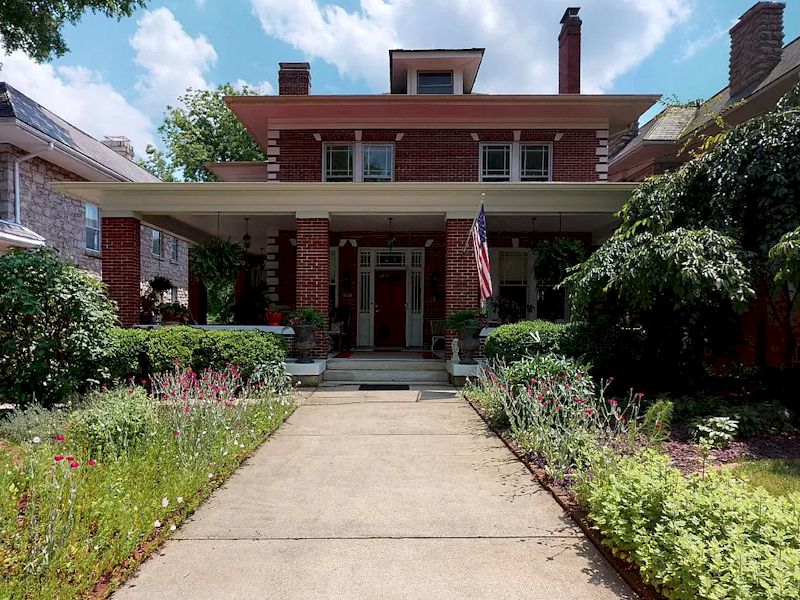
The Trundle House, 122 Chestnut Street

Much of the early history of 122 Chestnut Street has been covered before in the post on this home’s sister property, 124 Chestnut Street, known formally as The Chaney House, but more colloquially by Old West End neighbors as Sunshine Cottage, appropriately dubbed by its current owner Michele Rose Bowers.
The development of Chestnut Street begins with the enterprising real estate mogul and tobacco manufacturer, Weldon E. Williamson, who owned the property on which the Presbyterian Church now stands on the corner of Main Street and Sutherlin Avenue. When he acquired that land is not entirely clear but his property is shown on the Beers map of 1877. A widower, he and his daughter Dora Dean Williamson, set up a booming real estate business, buying up and selling land in Danville, as well as in Greensboro and Asheville. When Dora married Thomas Doe, the enterprise expanded and Dora established her own independent real estate venture, taking the name Dora Doe & Co. When her holdings in Danville began to falter in 1884, her father stepped in and saved her from bankruptcy, selling off, on her behalf, the land she had accumulated on the Main Street block, land which include nine lots on Chestnut Street.
James A. Henderson, a tobacconist as well, bought up the Williamson-Doe property, including the Williamson home. Henderson also bought at least two of the lots fronting on Chestnut Street. It may be presumed he developed those lots as rental properties—including The Chaney House at 124 Chestnut and the house next door, the subject of our post, the Trundle House at 122 Chestnut Street. All told he paid $9,750.00 for the Williamson-Doe property.
In 1903, James A. Henderson & Co, once touted as “one of Danville’s largest and best tobacco firms,” filed for bankruptcy and the properties were auctioned once again. Papers were quick to assure tobacco investors that all was well within the industry, and that Danville was not losing its esteemed position as one of the best tobacco markets in the world due to Henderson’s liquidation. Henderson had stake in other businesses, after all, including contracting for the mail, and it was the failure of those businesses, it was said, that caused his collapse. Though Henderson was forced to sell off his adjacent properties, the Main Street house was saved from the auction block, and when he died a few years later in 1907, his widow was allowed to remain in the home.
In 1909, the Presbyterian Church, looking for larger accommodations than their Jefferson Avenue address could provide, purchased the home from Mrs. Henderson, and in 1912 constructed the impressive Greek Revival edifice that stands there today.
Henderson’s bankruptcy had forced him to sell his properties at 122 (then 402) and 124 (404) Chestnut Street, which lots, by this time, had been developed by way of the construction of “twin” cottages (there are theories that the two houses once had matching rooflines, though there is no documented proof of this). The homes are thought to have been constructed about 1898. We know that, at the time of the auction, the lots had been developed, as indicated in the deed records.
The result of the auction was that 404 (The Chaney House, now numbered 124 Chestnut Street) was was purchased by George G. Temple for $1,200.00, while 402 (now 122 Chestnut Street) was sold to A.W. Jacobs on the 24th of September 1904.
Jacobs likely bought 122 Chestnut Street as an investment. Sixteen months later, in January of 1906, he sold the property to Harry Burns Trundle.

A son of Joseph Henry and Emily Thomas Trundle, Harry Burns Trundle was born in Frederick, Maryland, in 1875. He was named Burns for the Scottish poet with whom the Trundle family had a kinship.
It was in December 1899 that he became associated with Col. Al Fairbrother as a part owner of The Bee. He often recalled that newspaper being born during a blizzard.
In 1900, the Bee was sold to the Hon. Rorer A. James, owner of the morning Danville Register, and Trundle took over the management of both papers.
That same year, he married Eloise Redd Arrington of Henry County. The couple would have Three children together: Wilson Burns Trundle, Joseph White Trundle, and Anne Dillard Trundle.

In 1901, Trundle resigned to professionally reunite with Col. Fairbrother in an advertising business in Atlanta. A year later, he returned to Danville and became associated with Boatwright Brothers Company, Danville’s premier printer. He remained there until late 1903 when Mr. James again sought Trundle’s services and he returned to write for the newspaper. It was a year later he purchased the Chestnut Street home.

Probably no daily task at the newspapers excited Trundle more than his “Scoop’s Colyum.” He recognized that a certain amount of levity was good every day, and it became one of the newspaper’s most widely read features.
In January of 1926, Mr. Trundle left the Danville paper to purchase the Manassas Journal, which he intended to run as a partnership with his two sons.
“The occasion of Mr. Trundle’s leaving yesterday was a sad moment for many people of Danville in whose hearts a warmth of affection has been kindled for a man of many loveable qualities,” wrote the Danville Register and Bee of January 28, 1926. “His going established a keenly felt loss in an organization many members of which have worked pleasantly for a good span in their natural lives. Before he left there was a free expression of the belief that Mr. Trundle would, upon the establishment of his sons in the publishing business, return to Danville and resume his local affiliations.”
The home was purchased in August of that year by Beulah and C.C. Pollock for $8,000. Possibly they bought it as investment, or perhaps they simply found themselves in financial straights soon after having acquired the property, for in December, the Pollocks put the home into the hands of trustee, E. Walton Brown, in order to secure the funds to pay a debt. The bill came “due and payable” in August of 1928, and the Pollocks defaulted. The home went up for auction on the 12th of March 1931. The highest bidder, paying the winning bid of $5,540 was Harry Burns Trundle.
It seemed the prognostication that the newspaperman would return to Danville proved true.
Tragedy struck, however, on Saturday, December 12, 1936 when, on his way home for supper, Trundle was hit by an automobile while crossing Main Street at the corner of Chestnut – only a few yards from his home. His left leg was broken, and he suffered a severe blow to the head. He passed from his injuries early on the morning of December 18.
After Mr. Trundle’s passing and for the next decade, Mrs. Trundle remained in the home with her daughter Anne. By 1946, Anne had taken employment with the federal government as a typist, and the two women moved to Washington, D.C. The home was sold to to Nora M. Wiseman.
Nora was the wife of Plumer Wiseman whose family lived at 842 Main Street. Plumer died in 1944, two years prior to Nora’s purchasing the Chestnut Street property. Norma Wiseman was born Nora Eddie Mosely in 1888, the daughter of Beverly Brown Mosely and Florence L. Millner Mosely. In 1890, her father went suddenly mad and was committed to Southwestern Mental Hospital in Marion, Virginia.

Following her father’s commitment, she was adopted by her mother’s sister Nora, who had married her father’s cousin, E.G. Mosely, the popular pastor of Moseley Methodist Church who owned a home at 840 Main Street. This is the home in which Nora grew up.

Nora appears to have been the only child adopted out of the family, despite having older and younger siblings, and it’s unclear why. Her mother, it seems, moved to Charlottesville shortly after her husband’s hospitilization.
At Nora’s wedding to Plumer Wiseman in 1910, a newspaper article in the Danville Register and Bee described the marriage as “One of the most brilliant society events” between “two of Danville’s most popular young people.” The wedding was “at the handsome residence of Mr. E.G. Moseley, the home of the bride,” where she “entered leaning on the arm of her uncle Mr. E.G. Moseley, who gave her away.” Though the bride wore white, “Mrs. H.A. Wiseman, mother of the groom” wore “heavy black silk under marquisette, duchesse point lace” and Mrs. B.B. Moseley, the mother of the bride,” wore “black net over silk”. The article tells us by these descriptions that Nora was perhaps not formally adopted, since her mother is still recognized, and E.G. Moseley is referred to as her uncle rather than her father, and that the two mothers were, if not in mourning, than showing respect for the fact that the fathers of the marrying couple could not be in attendance, Mrs. Wiseman having lost her husband in 1902.
Nora and Plumer Wiseman had four children. Sadly, Nora’s eldest child and her namesake, Nora Moseley Wiseman, died at the age of four, on the 7th of December 1915, just two weeks after the death of her own father at Southwestern Hospital.
Mr. Moseley’s life was not as tragic as it may sound. Having spent his early life as a farmer before making his fortune in the tobacco business, he spent his time at Southwestern Hospital raising chickens who laid prize-winning eggs, some the size of a goose’s.

Dora lived in the Chestnut Street home as a widow for about ten years, her husband having died in 1944 at the age of 63 of a heart condition made worse by bronchial pneumonia which together led to heart failure.
In 1956, Nora sold the home to Eleanor Helene Howard Guerrant, an interior decorator who occupied the house until her death in 1982.
Eleanor was born in Danville on the 2nd of October 1899 to George Howard Guerrant and Bessie Hancock Guerrant. Eleanor never married, and after her death at Camelot Hall Nursing Home on Piney Forrest following a heart attack on January 16, 1982, the home was sold to Henry G. and Peggy O’Neil Talbot.
The Talbott’s had been married just weeks when they purchased the Chestnut Street home, and the couple lived there until 2000, when they sold it to James A. and Linda D. Stuller. Five years later, the home sold again to Christian Whicker and Naomi Shropshire who owned it for ten years before the home foreclosed and was subsequently sold to Frank Shields who owned it for a year before selling it to Michael Wayne and Kimberley Anne Bolling. During that time, from at least 2015 (possibly earlier) until 2018 when it was acquired by the Danville Redevelopment and Housing Authority, the house was used as rental property. As part of the city’s resale program, the home was purchased by Craig Oleinik and Blake Miller, but two years later, they pulled the plug on their rehabilitation efforts and sold the home to neighbor, Michelle Rose Bowers. For the first time since their construction by James A. Henderson at the turn of the twentieth century, both homes are owned by the same owner who has done astonishing work bringing both houses back to vibrant life.
Sources:
-Census and Vital records found at Familysearch.orgImages and vital information, including biographical sketches found at FindaGrave.com
-Death notices and other information found in the Danville Register, Danville Bee and other newspaper archives at Newspapers.com and GenealogyBank.com
-Census, Directory, Newspaper, and other information compiled by Paul Liepe


You May Also Like

The Laban Silverman House, 221 Jefferson Avenue

The H.W. Brown House, 878 Green Street